Kings and capitals make the headlines of history. Ordinary life in Shewa was held together by quieter things: the parish church and its calendar, neighbours who owed each other help, a household that knew how to receive a guest, and craftsmen who made what the country needed.
This article looks at four of those things. None of them belongs only to Shewa. But each took a particular shape in Shewa, and several of them spread from Shewa to the rest of the country.
The parish and the calendar
The church was the frame of the Shewan year. Every parish church held a tabot, the consecrated tablet that makes a building a church, and the great feasts brought those tablets out into the open.
W. C. Harris watched Timket, the feast of Epiphany, at Ankober in the early 1840s. Every church in and near the town carried its tabot to the open square in front of the palace. The governor of the town received the procession and escorted it down to the Airara river, where the water was blessed and people went into it. Harris noted that even household pots were purified that day in the blessed water. At the end of Lent in 1842 he estimated that some eighty priests from the church of Saint George alone walked in the procession.
The church was also the school. At Saint George’s in Ankober in the 1830s, the missionary Johann Ludwig Krapf found sixty children studying under six teachers: ten learning to read, twenty learning chant, thirty learning qene, the church’s poetry. That was the ladder of education in Shewa for centuries, from reading the Psalms to composing verse.
Above the parishes stood the monasteries. Debre Libanos, founded by Saint Tekle Haymanot, was the great house of Shewan monasticism, and its abbot, the Ichege, ranked second in the Ethiopian Church only to the Abuna. Shewan kings built and rebuilt churches as a matter of duty. Wossen Seged restored the church of the Virgin at Debre Libanos. Sahle Selassie founded three churches in Ankober alone.
The church also held land, and that gave it a direct place in the rural economy. Before 1975, peasants who worked church land paid their dues to the church or monastery instead of to the crown. In northern Shewa the usual form of land right was rist, a hereditary claim shared by the descendants of a founding ancestor. In Menz, the anthropologist Donald Levine recorded a favourite proverb that sums up how deep that sense of inheritance ran: Ye Menze rest ba shi ametu la balabetu, “Menz rest belongs to its owner until the thousandth year.”
The iddir: neighbours who bury each other
If you live in an Ethiopian town today, you almost certainly belong to an iddir (Amharic ዕድáˆ), a burial association. Members pay a small regular fee. When a death comes, the iddir provides money, labour and food, and its members attend the funeral and mourn with the family.
The iddir is not ancient. The social historians Alula Pankhurst and Damen Haile Mariam trace it to migrants in early twentieth-century Addis Ababa, the new Shewan capital, from where it spread across the country. The Norwegian anthropologist Svein Ege, who has worked for decades in the Mafud area of North Shewa, writes that it has spread so widely “that it may now be regarded as part of a common Ethiopian civilization.”
Ege’s fieldwork shows how the iddir works in rural Shewa. In upper Mafud, around the market town of Armanya and the ward of Ayne, the iddirs were formed in the 1960s and early 1970s. Each one rests on a written pact, the wel, discussed in a founding assembly and signed by every member. Each has an elected leader called the dagna, which means “judge,” along with a secretary and a cashier. The title tells you what the job is. The judge enforces rules the members have agreed to. He is not supposed to be a big man running things for himself.
The rural iddir has teeth. Membership for every household in its area is, in practice, required. Late payment brings a small fine; refusal brings larger ones, then suspension, then expulsion. Expulsion means more than losing a benefit. No member may help the expelled household, lend it tools, or even let it take fire from the hearth. Ege’s point is that this threat is rarely used, because everyone knows it is real. The aim is inclusion, not exclusion.
What the iddir changed is moving. Before it, Ege’s informants told him, few people came to a poor man’s funeral. After it, everyone in the iddir had to come. One informant explained that the iddir is called “the burier of the poor” (deha qebari). Ege records the funeral of a local priest attended by at least eight iddirs and more than 500 people.
The iddirs also bought equipment that no single household could afford: spades for the grave, large cooking pots, plates, sometimes a tent. Members could borrow them for baptisms and weddings. Ege calls this modernity coming to the rural community.
In the lowland hamlet of Wanza near Shewa Robit, the iddir pact of 31 December 1987 set out what each death would bring: 15 birr from the cashier, plus three injera (the flat fermented bread of the Ethiopian table) and a load of wood from every member. Later rules added help to rebuild a burnt house and to share the meat when an animal died.
Neighbours, work and favour
The iddir grew out of an older web of help between neighbours. Ege describes it with three Amharic words.
Debo is the work party. A farmer with fallow land to break calls a dozen or two neighbours with their oxen, and the day ends with food and drink. Wenfel is exact exchange: you weed my field for a day, I weed yours. Welata is wider. It means favour, kindness, obligation. One of Ege’s assistants explained why his brother hoed a neighbour’s plot in the busiest season with the phrase “I owe much welata.”
That is the moral centre of Shewan village life. You help because help has been given, and because a good neighbour does.
Hospitality: from the coffee tray to the king’s hall
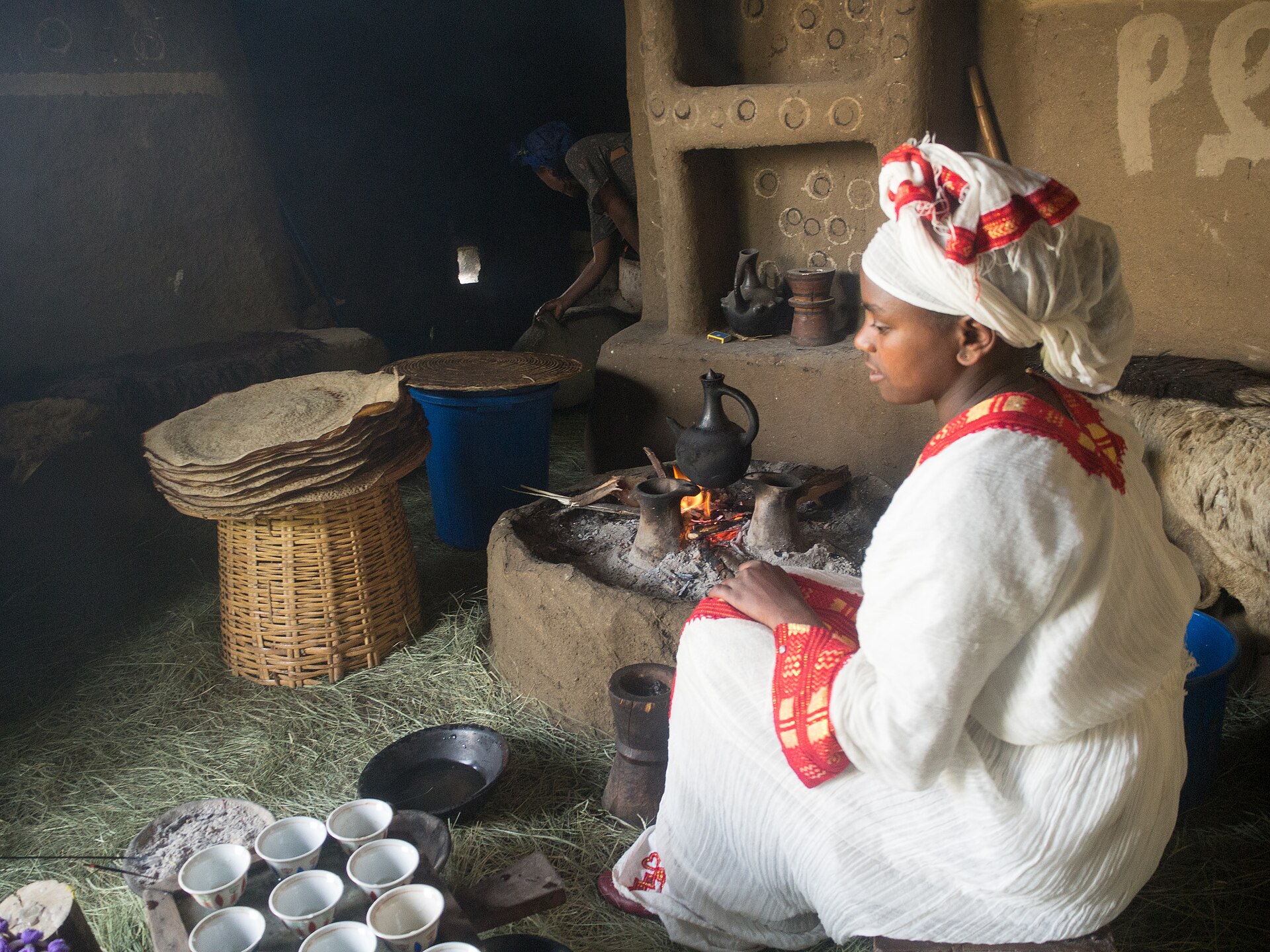
The same idea runs up to the top of society. The most familiar form is the coffee ceremony, usually performed by the woman of the house. Green beans are roasted over an open flame and their smoke is offered to guests. They are ground in a wooden mortar, brewed in a clay jebena and poured in three rounds, which in Amharic are called abol, tona and bereka, the last meaning “blessing.” Grass and flowers are often spread on the floor. To sit through all three rounds is to be received properly.
Shewan tradition treats refusing hospitality as a serious wrong. Harris recorded a legend from Menz about Lake Alobar. The Virgin Mary, it was said, came to a rich household hungry and offered to grind grain for wages. The grain turned to flour at her touch, but the master refused to pay her. As punishment the place became a lake. Ever since, Harris was told, the people of the district had supplied the shepherds with bread of the whitest flour at the feasts of Debre Tabor and of the Virgin.
At the court, hospitality became policy. Sahle Selassie opened the royal granaries in famine years and handed out oxen and mules when disease killed the farmers’ animals. Menelik built the Gibr Adarash in his palace at Addis Ababa for the gibir, the royal feasts at which he fed great numbers of his subjects. In Shewan thinking a king was, among other things, the country’s chief host.
Craft
Royal Ankober was a town of workshops. An Italian guide of 1938, looking back, listed its silversmiths, blacksmiths, tailors, embroiderers, weavers and tanners. Harris describes how, after each harvest, scribes sent by the crown registered what went into the royal granaries.
Menz had its own craft, wool. Its sheep gave a coarse dark cloth, sekdat, which Harris says was the only tribute Menz paid to Sahle Selassie, used for the royal tents. Farmers in Menz Mama still shear their sheep to make the bernos, a heavy woollen cloak, and another local cloth called zitet, according to a 2025 survey by researchers at the Ethiopian Biodiversity Institute. It was fitting that Ethiopia’s first wool factory, opened on 1 January 1965, was built at Debre Birhan, on the edge of the sheep country.
Shewa also kept the art of church painting alive. Fiche, in Selale, was home to the religious painters Alaqa Gebre Selassie Adil (1881–1975), Emealaf Hiruy (1907–1971) and Ale Felege Selam (1924–2016). Ankober’s Medhane Alem church holds paintings by Aleqa Eleyas, born around 1861. And Ankober gave Ethiopia Afewerk Tekle, born there in 1932, who decorated the walls of his home town as a child before he became the country’s best-known modern artist.
A social order, not a museum
Put these together and you see a society that knew how to look after itself. The church gave it a calendar, a school and a moral language. Neighbours worked through debo, wenfel and welata. The iddir turned that neighbourliness into an institution that buried rich and poor alike. Hospitality ran from the coffee tray to the king’s hall. Craftsmen clothed, armed and decorated the country.
Much of this survives in every Shewan village and in every Addis Ababa neighbourhood. That is the best argument for caring about it. It is not a museum piece. It is still how people live.
Sources
- Svein Ege, “Creating community: Burials, cooperation and exclusion in the Amhara eder (iddir),” History and Anthropology (2023). Creating community (text read at text)
- Alula Pankhurst and Damen Haile Mariam, “The Iddir in Ethiopia: Historical Development, Social Function, and Potential Role in HIV/AIDS Prevention and Control,” Northeast African Studies 7, no. 2 (2000): 35–57. The Iddir in Ethiopia
- William Cornwallis Harris, The Highlands of Aethiopia, vols. 2 and 3 (London, 1844). vol. 2 and vol. 3
- Bernhard Lindahl, Local History in Ethiopia (Nordic Africa Institute), Ankober and Menz entries. Local History in Ethiopia, Ankober entry and Local History in Ethiopia, Menz entry
- Teklewold Belayhun, Aweke Engdawork and Amine Mustefa, “Sheep Production System and Farmers’ Breeding Practices in North Shewa and South Wollo Zones of Amhara Region, Central Ethiopia,” International Journal of Veterinary Science and Research (2025). Sheep Production System
- Donald N. Levine, Wax and Gold: Tradition and Innovation in Ethiopian Culture (University of Chicago Press, 1965). Wax and Gold
- Wikipedia, “Coffee ceremony of Ethiopia and Eritrea,” “Ethiopian land reform,” “Debre Libanos,” “Debre Birhan,” “Menelik Palace,” “Sahle Selassie,” “Fiche, Ethiopia,” “Afewerk Tekle.” Coffee ceremony of Ethiopia and Eritrea , Ethiopian land reform , Debre Libanos , Debre Birhan , Menelik Palace , Sahle Selassie , Fiche,_Ethiopia , Afewerk Tekle
Image: Photo by Jean Rebiffé, via Wikimedia Commons, CC BY-SA 4.0
Church, iddir, hospitality and craft were how Shewan society held together, and they are the civilization the association exists to keep.how-society-worked