You reach Ankober from Debre Birhan across a high, bare plateau. Then the ground ends. The escarpment drops away thousands of feet towards the Afar lowlands, and on a ridge below the edge sits the old royal town of Shewa.
David Buxton, who made the trip by mule in the 1940s, wrote that “an absent-minded person might have fallen over it.” Below him he could see the ridge with two or three round churches among the trees, and at its end “a curious hill of artificial aspect, perfectly conical in shape and flattened on top.” That hill, he was told, was the site of the old residence of the kings of Shewa.
Ankober sits at about 2,465 metres, some 40 kilometres east of Debre Birhan. For roughly a century it was the capital of the Shewan kings. It deserves to be better known than it is.
How Ankober became a capital
There is a popular claim, repeated online, that Ankober was founded in the thirteenth century. We have not found a good source for it, and the historians who have studied the town tell a later and more precise story.
Rita Pankhurst, the historian of Ankober’s churches, records that Ankober was an Oromo settlement captured by the Shewan ruler Abiye, also called Qedami Qal, who ruled from about 1720 to 1745. His successor Amha Iyasus made it the capital. W. C. Harris, writing in 1844 from what he heard at court, says Amha Iyasus “conquered Ankóber, and removed his capital thither from Dokáket.” Mordechai Abir places the move some time between the 1750s and 1770s.
The name itself carries a tradition. Harris was told that Ankober meant “the gate of Anko,” after a queen who had ruled the mountain before the Shewan kings took it. Bernhard Lindahl’s gazetteer gives a similar reading, with ber meaning “gate” or “pass.” It is a good story, and we offer it as the tradition it is.
Amha Iyasus founded the first church in the town, dedicated to Saint George, around the 1750s. His son Asfa Wossen (1775 to 1808), a ruler more given to study and prayer than to war, settled the court firmly at Ankober and set out to improve it. He founded the church of Maryam, crowned with a bronze cross, and was buried in a mausoleum in its churchyard.
The court in the 1840s
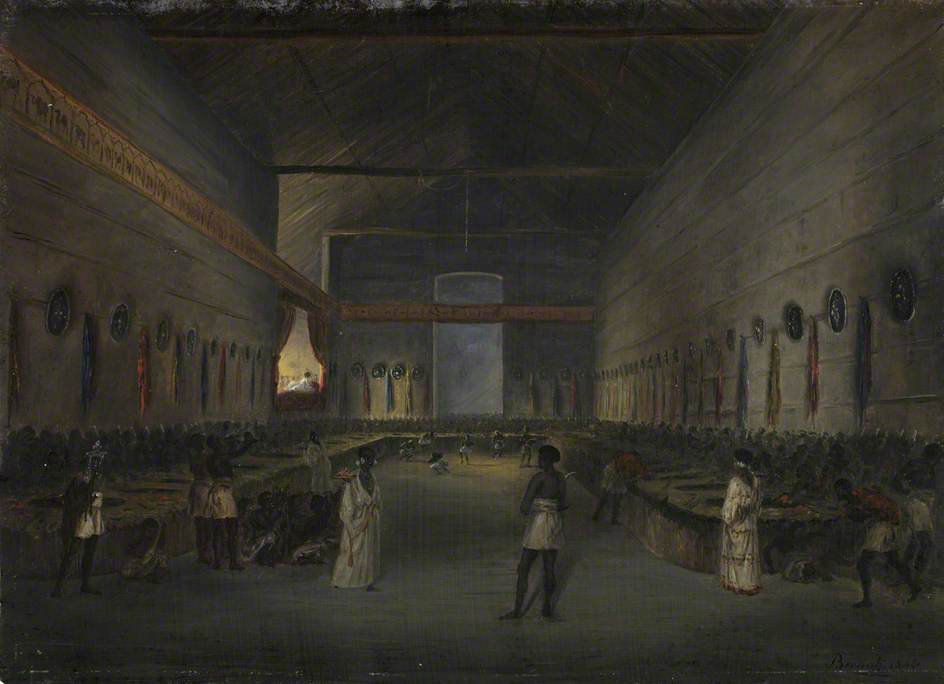
The best description of royal Ankober comes from the British mission of 1841 and 1842, led by Captain William Cornwallis Harris. Coming out of the forest, he saw the capital spread over a green mountain “shaped like… the fabled Sphynx.” The houses, home to “from twelve to fifteen thousand inhabitants,” covered the slope to the top, where a narrow neck led to a high cone, “the sphynx’s head.” On it stood the palace of the Negus, fortified with spiral lines of wooden palisades.
That figure was the town with the court in residence. Other observers give a figure of about 5,000 when the king was away, rising to 15,000 when he was there. Ankober was a court town. It breathed in and out with the king.
The town made things. An Italian guide of 1938, looking back, listed the trades of royal Ankober: silversmiths, blacksmiths, tailors, embroiderers, weavers and tanners. A Greek or Armenian merchant named Petros is said to have introduced the art of dyeing leather red and green. Sahle Selassie had a new residence built partly of stone by Greek masons.
The land around it was just as productive. Harris’s naturalists counted 28 varieties of sorghum, 24 of wheat and 16 of barley within five miles of the town. The mission also kept a weather register at Ankober from August 1841 to July 1842, and its two doctors treated between 2,000 and 3,000 patients in and around the town.
A town of five churches
Ankober was above all a church town. By Harris’s time it had five churches. Sahle Selassie founded three of them, beginning with Mikael in 1836, on a hill east of the palace. Mikael “came first in order,” Harris wrote. It was the king’s own church, and its tabot (the consecrated altar tablet, the heart of any Ethiopian church) went with him on campaign. A church of Tekle Haymanot followed in 1839, with a monastery attached. Medhane Alem, the church of the Saviour, was built by craftsmen brought from Gondar and took seven years to finish, in the reign of Sahle Selassie’s son Haile Melekot.
The churches were schools too. The missionary Johann Ludwig Krapf found 60 children studying at Saint George’s in the 1830s under six teachers: ten learning to read, twenty learning chant and thirty learning qene, the poetry of the church. At another church a teacher named Arkeledes taught chanting to about a hundred pupils.
At Timket, Epiphany, every church in and near Ankober brought its tabot to the open square in front of the palace. The governor of the town received them and escorted the procession down to the Airara river for the blessing of the water. Harris watched it in the early 1840s.
When the Italian explorer Antonio Cecchi came in 1878, the court had moved on, but he still called Ankober the principal seat of the Shewan clergy, with about 6,000 people and a Saturday market. The churches stood so close together, he wrote, that “singing could be heard from one church to the other.”
Kings, births and a royal wedding
Ankober is where Menelik II was born, on 19 August 1844. It is where Sahle Selassie, who died at Debre Birhan in 1847, was buried in secret at his church of Mikael, according to Cecchi.
It is also where Menelik married Taytu Betul. The wedding took place in the church of Medhane Alem on Easter Sunday, 29 April 1883. Medhane Alem still has paintings by Aleqa Eleyas, a painter born around 1861.
In the 1870s and 1880s Ankober was the place every foreign visitor to Shewa passed through. The Swiss engineer Alfred Ilg arrived in January 1879 and was greeted there before going on to the king. The French poet Arthur Rimbaud passed through in February 1887 with a caravan of rifles for Menelik.
After the capital moved
The sources differ on exactly when Ankober stopped being the king’s main seat. Lindahl’s gazetteer says Ankober was Menelik’s main seat until 1878, when he moved to Entoto. Menelik also spent long periods at Liche, to the west, in the 1870s, and Addis Ababa was founded below Entoto in 1886. What is clear is that by the 1880s the centre of Shewa had shifted south.
Ankober did not disappear. It became the state prison of the kingdom, under Wehni Azaj Welde Sadeq (1838 to 1909), who governed the town for more than forty years. Among those held there were the last king of Kaffa and Ras Mengesha Yohannes, son of Emperor Yohannes IV, who died there in captivity in 1906. The Djibouti railway, when it came, took away the caravan trade that had climbed the escarpment for generations.
In October 1916 Ankober was the scene of a bloody prelude to the battle of Segele, when the forces of Negus Mikael of Wollo killed Ras Lul Seged and much of his army there.
During the Italian occupation, the patriots of the resistance were active in the Ankober country under Dejazmach Zewde Abakoran and Abebe Aregai. The Italians answered with bombing and punitive raids. The historian Richard Greenfield wrote that large tracts of land around Ankober were depopulated, and that the house where Abebe Aregai used to sleep could still be seen on a ridge in that steep country. The churches of Ankober paid a price. Italian-led troops burned Saint George’s in October 1937, killing a priest; three priests were killed at Tekle Haymanot.
Why Ankober still matters
The numbers tell a hard story. Ankober had about 9,234 people in 1956. The Central Statistical Agency’s 2005 estimate was 2,288. The 42-kilometre gravel road from Debre Birhan was only overhauled in 2009.
Yet the town keeps its hold on Shewan memory. Mikael, the church Sahle Selassie built, survives. The round churches of Maryam and Medhane Alem were still well attended in the 1990s. The travel writer Philip Briggs found one long stone wall of Menelik’s palace still standing on the old hill. Manuscripts from before 1856 survive in Ankober’s churches, and a high share of them are in Amharic, which says something about the reading culture of the town.
Ankober also kept producing Ethiopians of national stature. The painter Afewerk Tekle was born there on 22 October 1932, decorated walls in his home town as a child, and went on to become one of the country’s most celebrated artists. Aleqa Atsme, who wrote a history of Ethiopia in Amharic, was from Ankober too.
For the Shewa Society Association, Ankober is not a ruin to be visited once. It is the place where the Shewan state learned to govern, worship, record and build. A town like that deserves a road, a museum and a future.
Sources
- William Cornwallis Harris, The Highlands of Aethiopia, vols. 2 and 3 (London, 1844). vol. 2 and vol. 3
- Bernhard Lindahl, Local History in Ethiopia (Nordic Africa Institute), Ankober entry. It summarizes Harris, Abir (1968), Cecchi (Da Zeila alle frontiere del Caffa, 1886), Rita Pankhurst’s work on Ankober’s churches (1994), Guida dell’Africa Orientale Italiana (1938), Greenfield (1965) and Buxton (Travels in Ethiopia). Local History in Ethiopia, Ankober entry
- Bernhard Lindahl, Local History in Ethiopia, Liche entry. Local History in Ethiopia, Liche entry
- Wikipedia, “Ankober,” “Afewerk Tekle,” “Menelik II.” Ankober , Afewerk Tekle , Menelik II
Image: Johann Martin Bernatz, “The Celebration of Easter in the Palace at Ankobar” (1842), British Library WD2209 fol. 17, via Wikimedia Commons
For about a century Ankober was the royal seat of Shewa, a town of churches, workshops and court ceremony on the edge of the eastern escarpment, and it still holds the memory of the kingdom.ankober