Most royal houses are remembered for their battles. The Shewan house deserves to be remembered for something harder: it kept a state running, generation after generation, in a country that had been cut off from the rest of the Christian kingdom.
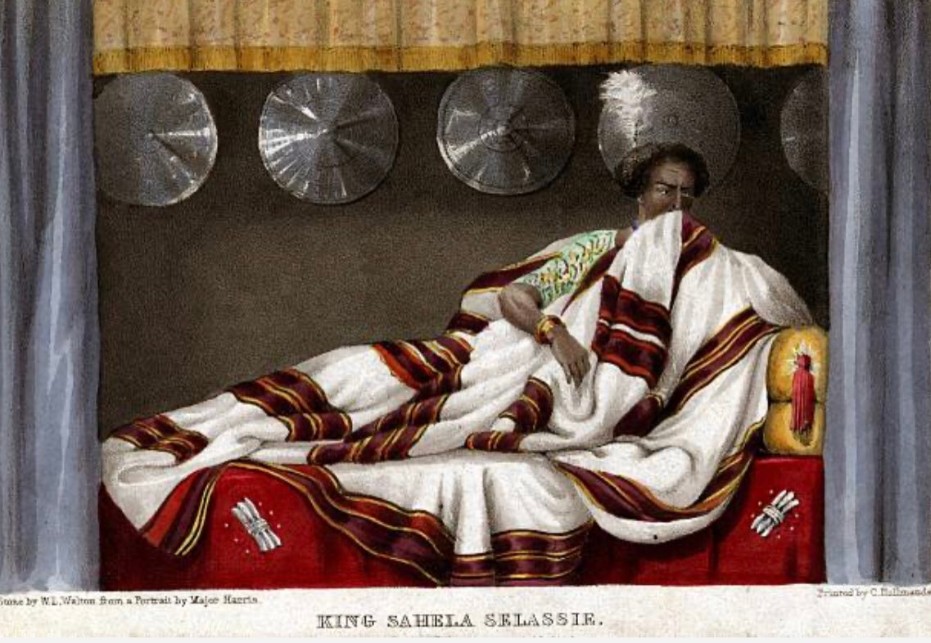
The line began in the cold parishes of Menz in the late seventeenth century. By the 1840s it governed from Ankober, signed treaties with Britain and France, kept granaries for famine years and sent its tabot (the consecrated altar tablet of a church) on campaign. Its descendants would give Ethiopia Menelik II and Haile Selassie.
This article follows that line from its founder, Negasi Krestos, to Negus Sahle Selassie, who died in 1847.
Negasi Krestos: the founder from Agancha
Negasi Krestos (reigned about 1682 to about 1703) was born in the parish of Agancha in Gera, the northern district of Menz. Two traditions explain his right to rule. The official account of the Shewan court, given by Serta Wold, a councillor of Sahle Selassie, traces him in the male line to Yaqob, a son of Emperor Lebna Dengel who stayed in Shewa. Another tradition, collected around 1840, gives him royal descent through his mother, whose father was said to be Ras Faris of Dair, a follower of Emperor Susenyos who took refuge in Menz. Both traditions agree on the essential point. The family saw itself as a branch of the Solomonic house that had survived in the highlands.
Menz in his youth was divided among rival chiefs. Their names are still the names of its districts: Gera, Lalo and Mama. Negasi defeated Lalo and Mamo and then, in a long series of fights, the powerful Gera himself. He founded the church of Kidane Mehret at Agancha and made it his base.
In 1683 he defeated the Arsi Oromo south of Menz and founded the town of Ayne on the frontier between Menz and Ifat, building a church of Saint Mary there. He also made an alliance with the Muslim leaders of Ifat. Richard Pankhurst credits him with moving the seat of Shewa to Debre Birhan; the French traveller Rochet d’Héricourt saw his stone palace there in 1840.
Negasi died of smallpox at Gondar, where he had gone to pay homage to Emperor Iyasu I. Donald Levine records that he was buried at the church of Fit Abbo, where his grave and the field he camped on, Nagassi Meda, were still remembered in the twentieth century.
Sebestyanos and the title of Meridazmach
His son Sebestyanos (about 1703 to about 1718) had to win his inheritance. Levine relates that Negasi’s will left the “throne” to his eldest son and his spear, silver cutlass and gilded shield to Sebestyanos. Drought and quarrels followed. Sebestyanos withdrew to Merhabete, returned, and made himself master of Menz.
He took the title Meridazmach, which his father had sought from Gondar and never received. It became the title of Shewa’s rulers for the next century. Pankhurst notes that Sebestyanos founded towns including Doqaqit, Ayne and Eyabar.
His death, as Levine tells it, was “a curious accident.” His son Qedami Qal was rebuilding churches burned in the sixteenth-century wars, among them Saint Michael at Doqaqit, and had the tabot from Ayne quietly carried there for the ceremony. Sebestyanos took this for rebellion and rode against his son. In the fight one of Qedami Qal’s servants killed him by mistake.
Abiye and Amha Iyasus: Ankober and the long peace with Gondar
Qedami Qal, also called Abiye (about 1720 to 1745), received the title of Meridazmach from Gondar. Rita Pankhurst credits him with taking the settlement at Ankober.
His successor Amha Iyasus (about 1744 to 1775) made Ankober the capital. William Cornwallis Harris, who heard the court’s own history in 1841, wrote that he “introduced several matchlocks from Gondar, conquered Ankóber, and removed his capital thither from Dokáket.” Mordechai Abir dates the move to some time between the 1750s and 1770s and writes that “it was during the reign of Ammehayes that the reconquest… really seriously began.” Amha Iyasus also founded Ankober’s first church, dedicated to Saint George, around the 1750s.
His most lasting idea was diplomatic. While the northern princes fought over Gondar, Amha Iyasus kept Shewa out of their wars and left the district of Wollo between the Geshen and Samba rivers as a buffer. His successors kept that policy for nearly a century.
When he went to Gondar in 1771, the Scottish traveller James Bruce met him and described a tall man with “the most affable manners.” Abir notes that the young emperor received him “more like an honoured ally than a vassal.”
Asfa Wossen and Wossen Seged
Asfa Wossen (1775 to 1808) was a ruler of a different temper. The Italian explorer Antonio Cecchi, drawing on Shewan accounts, describes him as more inclined to study and religion than to war. He settled the court at Ankober and worked to improve the town, while also keeping residences at Debre Birhan and Angolalla. He founded Ankober’s second church, Maryam, and was buried in a mausoleum in its cemetery. He was blind in his last years.
His son Wossen Seged (about 1808 to 1813) was the first Shewan ruler to style himself Ras, a title just below king. With his reign, the chronology of Shewa becomes firm. The British traveller Henry Salt mentions him in 1809 and 1810. His districts included Moret, Gedem, Marra Biete, Bulga, Mugher, Abichu and Debre Libanos. He restored the Church of the Trinity at Debre Birhan and the Church of the Virgin at Debre Libanos and built a new church at Sela Dingay. He was murdered in his palace at Qundi, north of Ankober, and named his young son Sahle Selassie as heir before he died.
Sahle Selassie: a state that took care of its people
Sahle Selassie (1795 to 22 October 1847) was a student at the monastery of Sela Dingay when his father died. With the support, it seems, of his mother Zenebework’s kinsmen in Menz, he was proclaimed ruler while still a teenager. In time he took the title Negus, king, of Shewa, Ifat, the Oromo and the Gurage.
His reign was tested early. Famine came in 1829. Cholera followed from 1830. One of his own generals, Medoko, rebelled and took some of the best Shewan matchlockmen with him. Then a two-year drought killed most of the domestic animals.
What Sahle Selassie did in those years is the heart of his reputation. Abir records that he opened the royal granaries to the hungry, distributed oxen and mules when plague killed the farmers’ work animals, and kept large stores of salt so that his people would not go short if the roads to the coast were cut. Abir’s verdict is striking: Shewa “can be considered, in a way, an archaic example of a welfare state.”
He reformed the law as well. Under earlier rulers, Abir writes, death sentences, mutilation and branding were common. Sahle Selassie limited executions to treason, sacrilege and murder, required his own approval for them, and where he could he converted death sentences into imprisonment or loss of property. In murder cases he pressed the victim’s family to accept blood money instead of vengeance.
He reorganized taxation, and his cash revenue around 1840 has been estimated at between 80,000 and 300,000 Maria Theresa thalers. He built up an armoury from a few score firearms to about 500 by 1840 and roughly double that by 1842. He invited foreign craftsmen and gave a Greek mason named Demetrios the revenue of a large village. He signed treaties of friendship with Britain on 7 June 1841 and with France on 16 November 1841.
He was also clear about limits. He welcomed doctors and craftsmen. He did not want foreign missionaries, and in 1842 he sent the Protestant missionaries away.
The British physician Charles Johnston, who visited, wrote that “the supremacy of political excellence is without hesitation given to the Negoos of [Shewa] throughout the length and breadth of the ancient empire of Ethiopia.” Johnston added: “To be feared by every prince around, and loved by every subject at home, is the boast of the first government of civilized Europe.”
His relations with the church were the hardest part of his reign. Shewa and Debre Libanos held to the Sost Lidet (“three births”) teaching on the nature of Christ, against doctrines favoured in the north. Disputes over appointments and doctrine ended with the new Abuna, Salama, excommunicating him in 1845. It is a sign of how seriously the Shewan state took its church that a king this strong had to bend more than once.
Sahle Selassie died at Debre Birhan in 1847. Cecchi reports that he was buried secretly at the church of Mikael in Ankober, the church he had founded in 1836 and whose tabot travelled with him on campaign.
What the line left behind
His son Haile Melekot ruled only eight years. When Emperor Tewodros invaded in 1855, the sick and discouraged king destroyed his food stores and his capital at Debre Birhan rather than leave them to the invader, and died that November. Tewodros, it is said, wept when he saw the body and had him reburied with the honours due to a king. The Shewan nobles who fought on were beaten in Bulga and handed over Haile Melekot’s eleven-year-old son, Sahle Maryam, who was taken north as a hostage. In 1865 that prince escaped from Magdala and came home. He was Menelik.
Through Sahle Selassie’s daughter Tenagnework, the same line produced Ras Makonnen and his son, the future Emperor Haile Selassie. Sahle Selassie was Haile Selassie’s great-grandfather.
From Negasi’s church at Agancha to Sahle Selassie’s granaries, the Shewan dynasty did not only survive. It governed. It kept courts and treasuries, built and restored churches, received ambassadors, and planned for famine. The line survived even the ten years of Tewodros’s occupation, came back with Menelik, and stayed at the head of the Ethiopian state until 1974. That continuity is one of the great achievements of Ethiopian history.
Sources
- Mordechai Abir, Ethiopia: The Era of the Princes (London: Longmans, 1968). Quoted here through the Wikipedia articles and the Lindahl entry listed below; not consulted directly.
- William Cornwallis Harris, The Highlands of Aethiopia, vol. 3 (London, 1844), p. 8. vol. 3
- Bernhard Lindahl, Local History in Ethiopia (Nordic Africa Institute), Ankober entry, citing Harris, Abir, Cecchi and Rita Pankhurst. Local History in Ethiopia, Ankober entry
- Bernhard Lindahl, Local History in Ethiopia, Menz entry. Local History in Ethiopia, Menz entry
- Donald N. Levine, Wax and Gold: Tradition and Innovation in Ethiopian Culture (University of Chicago Press, 1965). Wax and Gold
- Wikipedia, “Negasi Krestos,” “Sebestyanos,” “Amha Iyasus,” “Wossen Seged,” “Sahle Selassie,” “Haile Melekot,” “Ras Makonnen.” Negasi Krestos , Sebestyanos , Amha Iyasus , Wossen Seged , Sahle Selassie , Haile Melekot , Makonnen Wolde Mikael
Image: “King Sahle Selassie,” after W. C. Harris, *The Highlands of Aethiopia* (1844), via Wikimedia Commons
In a century and a half, a family from the cold highlands of Menz rebuilt Shewa into a working state with courts, granaries, churches and treaties of its own.the-line-that-held